

Two people are speaking.
Words leave one mouth, travel through the air, and land in another set of ears.
That part feels simple.
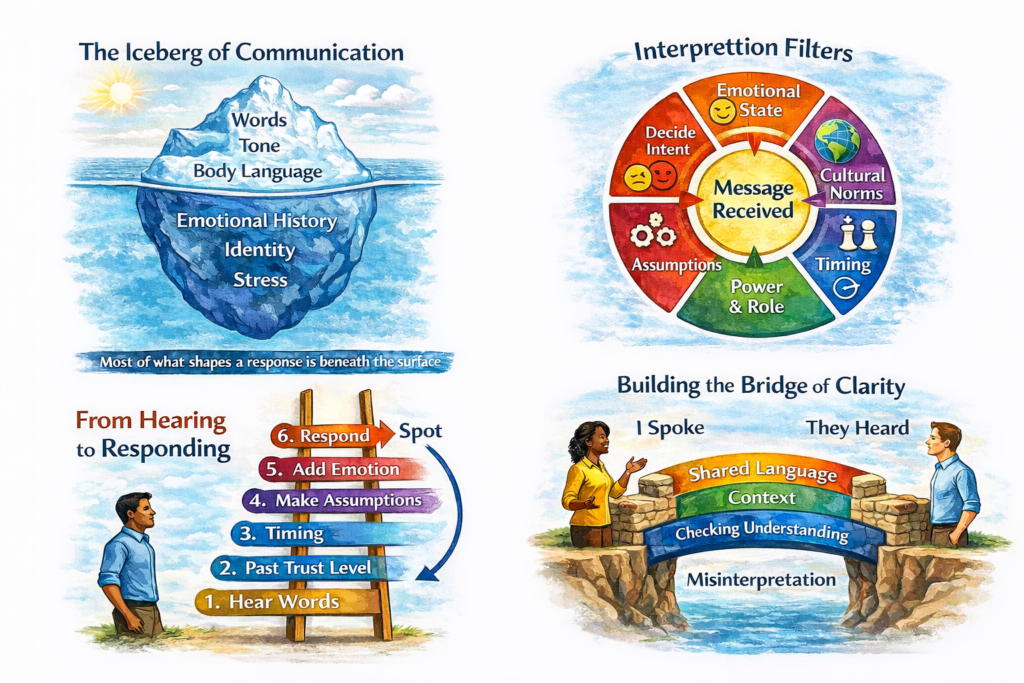
What’s not simple—and rarely visible—is everything that happens after hearing and before responding.
For leaders, this invisible space is where clarity is either created or lost.
The Invisible Middle
Imagine a simple visual:
- Two people facing one another
- Sound waves traveling from one to the other
- Between the ears and the mouth of the listener is a cloud, a filter, or a processing zone
Inside that space lives:
- Past experiences
- Emotional state
- Cultural norms
- Assumptions
- Power dynamics
- Stress levels
- Personal values
- Intentions (real or imagined)
The message doesn’t move directly from what was said to what is understood.
It passes through interpretation.
Leaders don’t lead conversations—they lead interpretations.
Why Interpretation Matters More Than Words
You may say:
“I need this by Friday.”
But the other person might hear:
- “I’m already behind.”
- “This is urgent because I’ve disappointed you.”
- “My workload doesn’t matter.”
- “This is normal—Friday is reasonable.”
Same words.
Different meaning.
The response that comes back is shaped not by what you intended, but by how the message was filtered.
Emotional Filters: The Color of the Moment
Emotions act like tinted lenses.
- When someone is anxious, neutral feedback can feel critical
- When someone is defensive, curiosity can feel like interrogation
- When someone is confident, challenge feels energizing
Leaders often underestimate how much current emotional load affects interpretation.
A stressed team member is not hearing with the same ears as a calm one.
Leadership insight:
Before focusing on what you’re saying, consider what emotional state the listener is in.
Cultural Filters: The Rules We Don’t See
Culture—organizational, national, generational—quietly sets rules for interpretation.
For example:
- Directness may be seen as clarity or as disrespect
- Silence may signal thoughtfulness or disagreement
- Questions may indicate engagement or challenge to authority
Leaders working across cultures must remember:
People don’t just hear words—they hear meaning through learned norms.
Leadership insight:
Misalignment isn’t always resistance. Often, it’s a difference in interpretation frameworks.
Reading Responses, Not Just Reactions
Leaders often react to what comes back, without asking why it came back that way.
A short reply
A delayed response
A defensive tone
A lack of follow-through
Each is a signal from the interpretation zone.
Instead of thinking:
“Why aren’t they responding well?”
Try:
“What might they have heard that led to this response?”
This shift moves leaders from judgment to curiosity.
How Leaders Can Communicate with More Clarity
1. Name the Invisible Middle
Normalize interpretation by acknowledging it:
- “Here’s my intent—tell me how this lands for you.”
- “What did you hear me say?”
2. Slow Down the Exchange
Speed increases misunderstanding.
Pausing allows meaning to surface.
3. Separate Intent from Impact
Your intent may be clear to you—but impact lives with the listener.
4. Ask Before Assuming
Instead of correcting responses, explore them:
- “Can you walk me through how you interpreted that?”
5. Watch Patterns, Not Moments
One response might be emotion.
A pattern of responses points to interpretation gaps.
Leadership Is Stewardship of Meaning
Great leaders don’t just transmit information.
They:
- Design clarity
- Reduce distortion
- Respect interpretation
- Adjust delivery without losing intent
The real work of communication doesn’t happen in the speaking.
It happens in the space between hearing and responding.
And leaders who learn to lead that space—lead people better.
Keywords: Culture and Engagement, Handling Conflict, communication, human communication, leadership communication, interpretation, emotional filters, cultural filters, clarity, misunderstanding, active listening, listening skills, emotional intelligence, emotional state, stress at work, cultural norms, organizational culture, workplace culture, power dynamics, assumptions, intent vs impact, conflict management, conflict resolution, productive conflict, disagreement, leadership insight, curiosity, judgment, feedback, difficult conversations, communication gaps, clarity in communication, leader as communicator, meaning, response patterns, cross-cultural communication, generational differences, employee engagement, employee motivation, staff dedication, performance management, staff effectiveness, leadership development, leadership skills, human dynamics, why do people misunderstand me at work, how to communicate better as a leader, why my team misinterprets what I say, communication problems at work, how to be clearer as a manager, why communication breaks down